







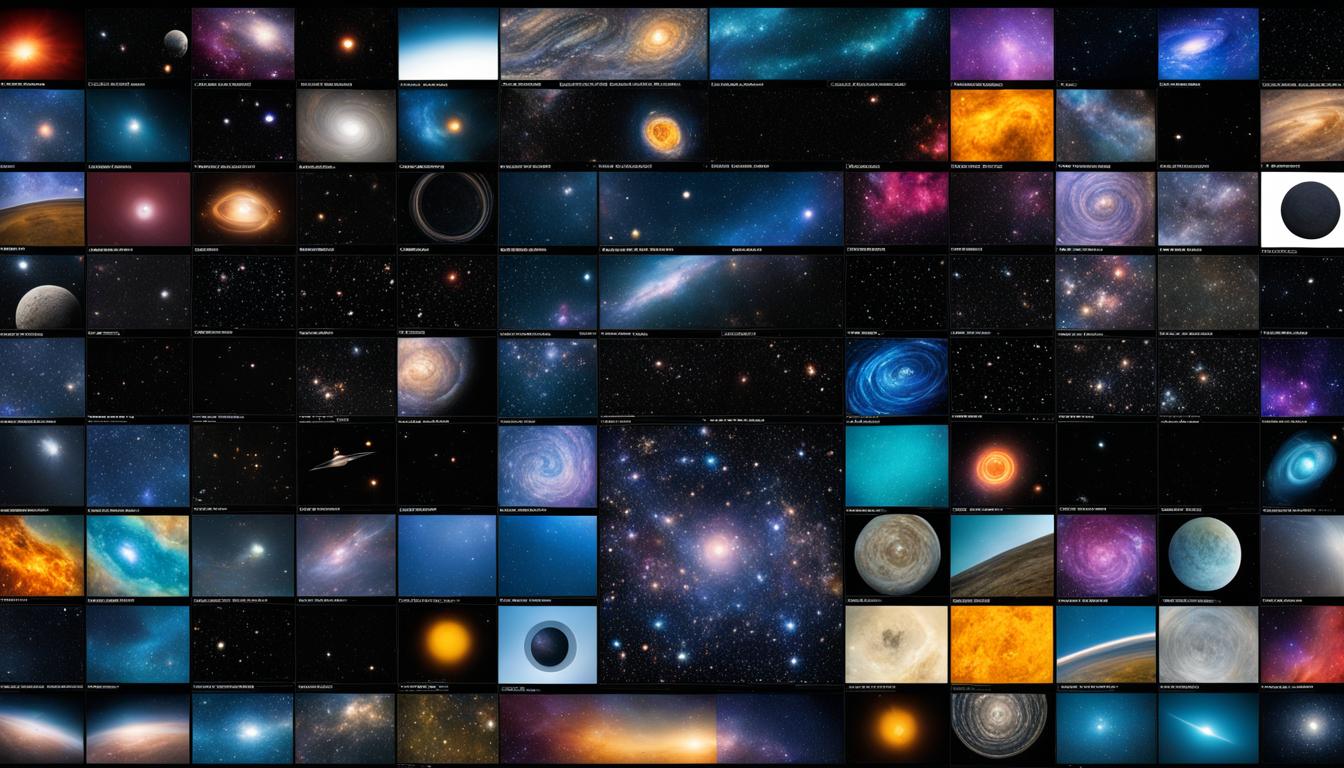
Astronomy has seen many big discoveries that changed how we see the universe. These include finding the Cosmic Microwave Background Radiation and discovering exoplanets and gravitational waves. These findings have changed our view of the universe and its laws.
This article looks at ten key discoveries in astronomy. They have expanded our knowledge and amazed both scientists and the public.
The Cosmic Microwave Background Radiation
In 1964, Arno Penzias and Robert Wilson found the cosmic microwave background (CMB) radiation. This was a big moment for astrophysics and cosmology. The faint glow of radiation showed strong proof for the Big Bang theory. It showed the early universe’s intense heat and density.
Unveiling the Remnants of the Big Bang
The CMB radiation is the oldest light in the universe. It comes from when the cosmos was just 380,000 years old. As the universe grew and cooled, this early light changed to longer wavelengths. Now, we see it as a faint, uniform glow.
This discovery has greatly helped prove the Big Bang theory. It has also helped us understand the early universe.
Impact on Cosmological Models
The finding of the cosmic microwave background changed how we see the universe’s big picture. By studying the CMB’s temperature changes, scientists learned a lot about the universe. They found out about its make-up, shape, and how it moves.
This info has made the Lambda-CDM model the top way to explain the universe’s growth and shape. This model is key for understanding the universe’s past and present.
The Discovery of Exoplanets
Astronomy has changed a lot since we found exoplanets, which are planets outside our solar system. Since 1995, scientists have found thousands of these planets. They range from huge gas giants to small, Earth-like ones. This has changed how we see planets and the kinds of worlds out there.
Redefining Our Understanding of Planetary Systems
Exoplanets have changed what we know about how planets form and change. By looking at these planets, scientists have learned a lot about how planets start and how they can be different. This has led to a new wave of research, looking for planets that might have life.
These discoveries have also made people more curious about space and if there’s life elsewhere. With better telescopes and ways to see the universe, finding out more about exoplanets is still exciting. It’s a key part of understanding space and searching for life beyond Earth.
Hubble’s Observations of the Expanding Universe
In the early 1900s, Edwin Hubble changed our view of the universe. He used the Hubble Telescope to show that the universe is always getting bigger. This was a major discovery.
Hubble found that galaxies far from us are moving away. This idea helped start the Big Bang theory. It said the universe began from a tiny, dense spot and has been growing.
This idea was new and challenged old beliefs. It opened up new areas in studying the universe, like cosmology and astrophysics.

Hubble’s work was a big step in understanding the universe’s start and growth. His findings have greatly influenced how scientists study the universe today.
The Science of Dark Matter and Dark Energy
The universe is full of mysteries, and none more intriguing than the invisible forces shaping it. Dark matter and dark energy are two such forces that have puzzled scientists for years. They are key to understanding the universe’s true nature.
Unraveling the Invisible Forces Shaping the Cosmos
Dark matter is a mysterious substance that affects visible matter through gravity. It makes up about 85% of the universe’s mass. Scientists are still trying to figure out what it’s made of and how it interacts with the universe. Research on dark matter could change how we see gravity and the universe’s forces.
Dark energy is another mystery, driving the universe to expand faster. It’s about 68% of the universe’s energy. Finding out about dark energy could change our view of space, time, and the universe’s future.
Studying dark matter and dark energy is crucial in modern science. As scientists learn more, these mysteries will likely lead to more amazing discoveries. They will help us understand the universe and our role in it.
Gravitational Waves: Ripples in Spacetime
In 2015, scientists made a big find with the Laser Interferometer Gravitational-Wave Observatory (LIGO). They detected gravitational waves for the first time. These waves are like ripples in spacetime, as Albert Einstein predicted. This breakthrough started a new field in astronomy, letting us study violent events in space.
Confirming Einstein’s General Theory of Relativity
Finding gravitational waves was a big deal in astrophysics. It proved Einstein’s General Theory of Relativity right. This theory says gravity bends spacetime, not that objects pull on each other. Seeing these waves proved Einstein’s idea and changed how we see the universe.
Gravitational waves have opened a new chapter in astronomy. Scientists can now study powerful events like black holes and neutron stars merging. By looking at these waves, researchers learn more about gravity, spacetime, and the universe’s evolution.
The Cosmic Microwave Background Radiation Polarization
The cosmic microwave background (CMB) radiation is like a time capsule from the Big Bang. It has given scientists a lot of clues about the early universe. The discovery of its polarization has opened up new doors to understanding the universe’s early days.
Polarization means the electric field in the CMB photons is lined up. This happens because of gravity and early universe’s density changes. By looking at how the CMB is polarized, scientists can learn about the universe’s growth. They can see how it changed from the Big Bang to the first stars and galaxies.
Studying CMB polarization has helped scientists improve their models of the universe’s start and growth. It also confirms the Big Bang theory. These findings show how gravity, dark matter, and dark energy work together to shape the universe.
As we learn more about CMB polarization, we’ll uncover more secrets of the universe’s beginnings. This shows how astrophysics and cosmology keep expanding our knowledge. They help us understand the complex universe we live in.
Discoveries from the Kepler Space Telescope
The Kepler space telescope was launched in 2009 and changed astronomy and astrophysics. It has found thousands of exoplanets, including some that might be like Earth. This has greatly expanded what we know about planets in other systems.
Revolutionizing Our Search for Habitable Worlds
Kepler found many exoplanets in our galaxy by watching stars for changes in brightness. These changes mean there could be billions of planets that might support life. This makes us think that life might be more common in the universe.
Kepler also told us about the size, mass, and star types of these planets. This helps scientists find planets that could have life. They look for those that are similar to Earth and are in the right place to have water.
The Kepler mission changed how we see planets and life beyond Earth. With new technology, scientists are ready to make more big discoveries. They aim to learn more about the universe and what’s in it.
The Accelerating Expansion of the Universe
In the late 1990s, scientists made a big find. They saw that the universe is not just getting bigger, but it’s getting bigger faster. This changed how we see gravity and the universe’s rules. They found that something called dark energy is making the universe expand faster.
Challenging Our Understanding of Gravity
This big discovery changed how we think about the universe. Before, we thought the universe would slow down expanding. But now, we see it’s speeding up. This is because of dark energy, a force we don’t fully understand.
Scientists are working hard to figure out what dark energy is. They want to know how it affects the universe’s growth. This mystery has made us rethink our understanding of gravity and the universe.
Science: The Cosmic Distance Ladder
Understanding the size of the universe is key in astrophysics and astronomy. The cosmic distance ladder helps us measure these vast distances. It uses methods like standard candles and parallax to find the distances to far-off galaxies and structures. This gives us a clear picture of the universe’s layout.
Measuring the Scale of the Universe
The ladder begins with stars in our Milky Way galaxy and moves to more distant objects. It includes variable stars, supernovae, and galaxies. Each step helps us measure distances more accurately, showing us the universe’s true size.
This method has changed how we see the universe’s structure and its history. It has shown us the vastness of space and helped us understand the universe better.

Knowing the universe’s size is crucial for many fields, like astrophysics and cosmology. By measuring distances to far-off objects, scientists learn about the universe’s workings. This helps answer big questions about where we come from, what we’re made of, and where we’re going.
The Cosmic Web: Mapping the Large-Scale Structure
The universe is more than just a random mix of galaxies. It’s a complex network of filaments, clusters, and voids. This network, known as the Cosmic Web, shows us the matter’s distribution and the forces shaping the cosmos.
Cosmologists and astrophysicists are uncovering the Cosmic Web’s secrets. This work shows the universe’s incredible complexity. By studying the large-scale structure, they understand the cosmos’s evolution from the Big Bang to now.
The Cosmic Web is key in cosmology and astrophysics. It helps us see the universe’s fundamental forces and processes. As we learn more about it, we’ll make new discoveries that change our understanding of the cosmos and our role in it.
The Higgs Boson: Completing the Standard Model
The discovery of the Higgs boson at the Large Hadron Collider (LHC) in 2012 was a major breakthrough. This particle was the last missing piece in understanding the universe and its forces. It was predicted by the Standard Model.
The Higgs boson is key to the Standard Model. It gives mass to elementary particles. Finding it at the LHC, run by CERN, proved the Standard Model right. It also opened new doors in understanding the universe.
This finding greatly improved our grasp of particle physics. It also led to new research in astrophysics. Scientists can now explore dark matter, dark energy, and the universe’s evolution better.