







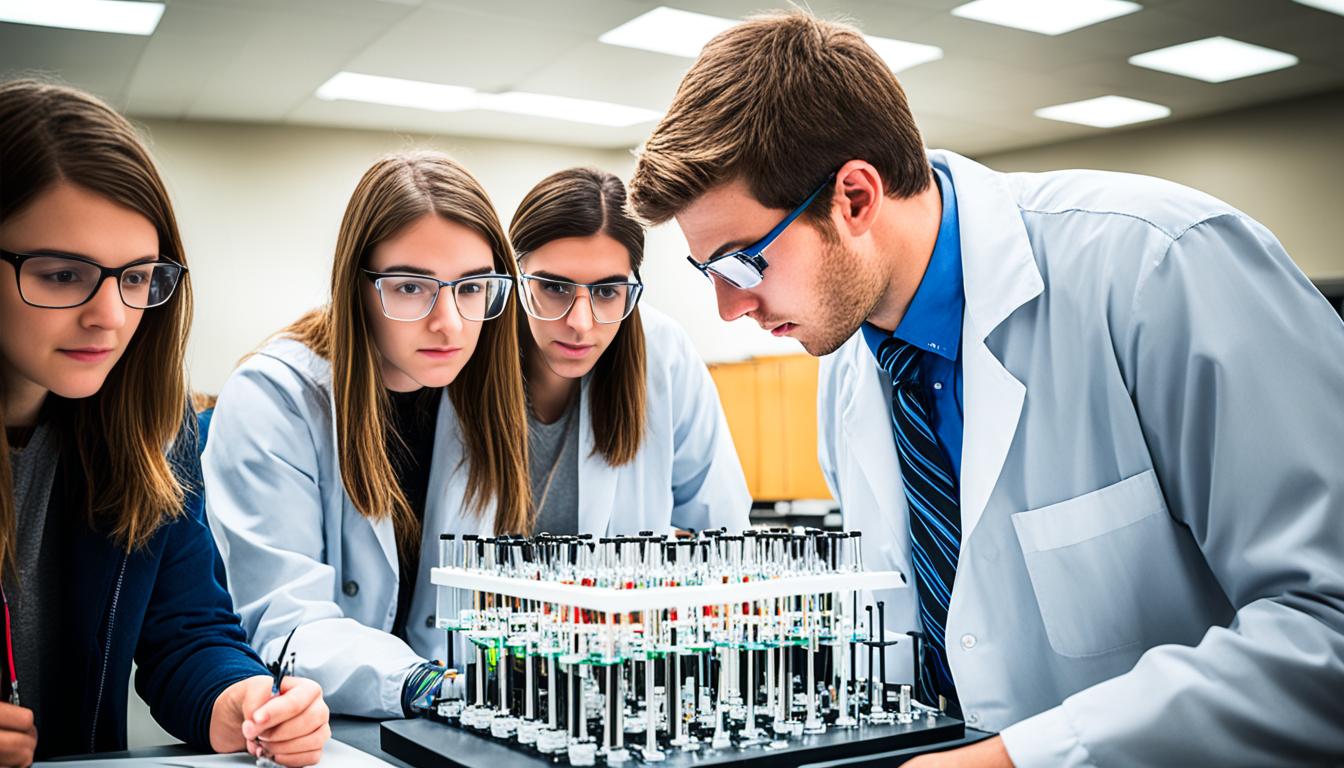
Teaching critical thinking skills is key in today’s education. Using science education is a great way to do this. By doing hands-on experiments and asking questions, students learn important analytical skills and problem-solving abilities.
Encouraging scientific curiosity is central to this method. When students explore the world, ask questions, and investigate, they start to think deeply about what they learn. This makes them more interested in science and gives them the skills to tackle complex problems.
Learning about evidence-based reasoning helps students check facts, make smart choices, and come up with theories. This skill is key in science and useful in many areas of life.
Adding science to other subjects helps students think more critically. When they see how science applies to everyday life and other subjects, they understand the value of critical thinking better.
Fostering Scientific Curiosity from an Early Age
Starting to spark scientific curiosity in young students is key to boosting their critical thinking. By giving them hands-on experiments and observations, teachers can light up their curiosity. This way of inquiry-based learning teaches them important skills like solving problems, analyzing data, and checking information.
Hands-on Experiments and Observation
Letting students take part in hands-on learning experiences can grow their scientific curiosity and love for science. Activities like watching a caterpillar grow or doing simple experiments with common items make learning fun. These activities push students to explore and grasp scientific concepts better.
Encouraging Questions and Exploration
Creating a space where students feel free to ask questions and test their ideas is vital for scientific curiosity. By promoting inquiry-based learning, teachers help students think critically and understand science better.
Developing Analytical Skills Through Science
Science education is key to sharpening students’ analytical skills. It teaches them to collect and understand data, make hypotheses, and reach conclusions based on evidence. This process helps build important skills like solving problems, thinking logically, and making critical decisions.
Through scientific experiments and discussions, students learn to analyze information and spot patterns. These skills are crucial for success in school and work. They help students tackle challenges with a clear, analytical approach. This prepares them for careers that need strong analytical skills, scientific reasoning, data analysis, and problem-solving abilities.

Students in science classes learn to ask tough questions and test their ideas. This not only deepens their knowledge but also boosts their critical thinking skills. These skills are in high demand in today’s fast-paced job market. Science education equips students with the analytical abilities needed for success in many areas.
The Importance of Evidence-Based Reasoning
Evidence-based reasoning is key to critical thinking. It teaches students to look at information, check sources, and make decisions based on solid data. This way, they learn to make informed choices and think deeply.
Students gain important skills like spotting bias, checking source credibility, and knowing facts from opinions. This helps them in school and real life.
Teaching Students to Evaluate Information
Learning to reason with evidence is vital for students. It helps them tell truth from lies, spot logical mistakes, and make smart choices. This boosts their ability to think critically and understand information well.
The scientific method is a great tool for this. It focuses on observing, making hypotheses, and drawing conclusions from data. By using this in class, teachers teach students the value of critical thinking and evidence-based decisions.
This prepares them to tackle complex problems with a sharp, analytical mind.
Incorporating Science into Interdisciplinary Learning
As educators, we know how big of an impact science has when mixed with other subjects. By linking science to math, history, or language arts, students see how science helps in real life. This way, they make connections across subjects, solve complex problems, and understand how different areas are linked.
This method makes students more engaged, better at solving problems, and values science more. Seeing how science and other subjects work together makes them think critically and solve complex issues. This is key for dealing with today’s complex problems.
Connecting Science to Real-World Applications
Science in interdisciplinary learning shows students how scientific ideas work in everyday life. It could be looking at how past scientific discoveries changed history, the math in engineering, or scientific themes in literature. These examples show the strength of STEM education.
Preparing students for the future means using science with other subjects. This approach helps students become not just science smart but also good at solving real-world problems. It boosts their learning and personal growth.
Promoting Critical Thinking Through Inquiry-Based Learning
Inquiry-based learning is a great way to boost critical thinking in science classes. It makes students ask their own questions and design experiments to find answers. This method sparks curiosity and encourages students to learn on their own.
Students learn to spot problems, collect and review data, and make conclusions based on evidence. This helps them develop key critical thinking skills.
This approach lets students take charge of their learning. It helps them solve problems and understand science better. By doing this, students learn to think deeply, explore their interests, and actively participate in learning.
When students investigate their own questions, they start to think more critically. They learn to analyze information and make logical conclusions. This improves their grasp of science and prepares them for future challenges that need problem-solving and critical thinking.
Fostering Collaboration and Peer Feedback
Creating a team environment in science classes boosts critical thinking. Students work together on projects and talk in groups. This way, they share ideas, see things from different angles, and give each other helpful feedback. It helps them listen well, think about other views, and get a deeper understanding of science.
Group Experiments and Discussions
Group activities help students learn to work as a team, talk well, and learn from each other. In group experiments, they plan, do, and look at their results together. This builds teamwork and problem-solving skills. Group talks let them discuss science, question each other, and give useful feedback.
Sharing ideas and evaluating each other’s work is key to critical thinking in science. As they work together, students get better at critical thinking, speaking out, and solving tough science problems with a team.
The Role of Science in Developing Problem-Solving Skills
Science education is key in teaching students how to solve problems. It uses the scientific method to help students tackle complex challenges. This method includes identifying problems, making guesses, designing tests, and looking at results.
This process helps students think critically. They learn to break down problems, find important information, and use logic to find solutions. It’s a great way to learn how to solve real-world problems.
The scientific method teaches students to think like problem solvers. It helps them learn to analyze data, question their ideas, and make logical conclusions. These skills are important for dealing with today’s complex issues.
Science education in schools helps students become better problem solvers. Scientific experiments are hands-on and focus on questioning and testing ideas. This approach boosts critical thinking and analytical skills.
Science is vital for preparing students for a complex world. It gives them the skills to succeed in many areas of life. By teaching a scientific mindset, educators prepare students to face problems with confidence and creativity.
Embracing Failures as Learning Opportunities
In the world of science, seeing failures as chances to learn is key. Not every experiment works out as planned, but these moments can teach us a lot. By seeing mistakes as ways to get better, teachers can help students grow resilient and brave.
Encouraging a Growth Mindset
Having a growth mindset is vital in science class. When students see challenges as chances to grow, they don’t see failures as the end. This mindset helps them see that finding answers often means trying different things. By building this resilience, teachers help students think deeply and solve tough problems.

Science classes should be places where students feel free to try new things and learn from their mistakes. By seeing failures as chances to learn and pushing for a growth mindset, teachers can help students reach their full potential. They become bold, creative, and ready to tackle complex problems.
Integrating Science into the Curriculum
Adding science to the overall curriculum can greatly improve critical thinking in students. By linking science with subjects like math, English, and history, teachers make learning more connected and interesting. This way, students learn to use science in different areas, helping them solve problems and think deeply across subjects.
Science in the curriculum makes education more complete and prepares students for life. It helps students see how science connects to other subjects. This approach boosts STEM education and teaches critical thinking for today’s complex world.
Science can be added to the curriculum in many ways. For example, through projects that mix science with English or history, or through activities that let students explore science by doing experiments. These methods help students use their science knowledge in various situations. This makes them confident, adaptable, and good at solving problems.
The Benefits of Critical Thinking for Future Success
Learning critical thinking in science education has big benefits for students’ future. It helps them analyze information, think deeply, and solve tough problems. These skills are key in school, work, and life.
Science education makes students independent learners and great problem-solvers. It teaches them to be adaptable and clear in their communication. These are key for doing well in a world that’s always changing.
These analytical skills help in many careers and support lifelong learning. Students can face challenges, make smart choices, and help their communities and the world. Science education uses experiments, inquiry, and teamwork to build critical thinking skills.
By adopting a growth mindset and learning from mistakes, students become resilient and adaptable. Critical thinking skills from science education prepare them for success in many areas. They’re ready for a life of achievement and making a difference.