







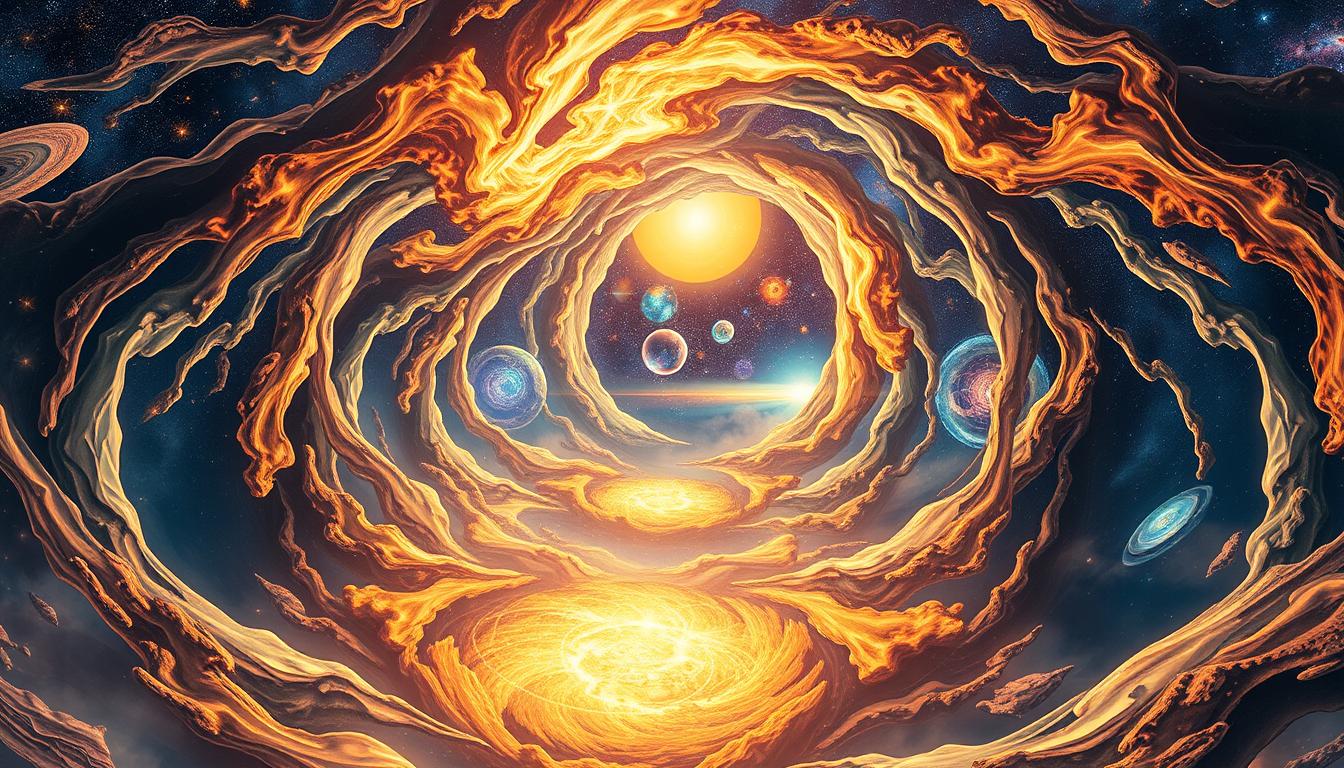
The multiverse theory suggests our universe is just one of many. These universes exist in a vast multidimensional space. This idea comes from the many-worlds interpretation, which says every quantum event creates a new universe.
This theory challenges how we see the universe and its laws. With trillions of galaxies, each with billions of stars and planets, the idea of other universes is exciting. It leads to discussions about parallel universes and the many-worlds interpretation.
Understanding the Concept of Multiple Universes
The idea of parallel universes is central to the multiverse theory. It suggests that many universes exist side by side, each with its own rules and constants. This concept is rooted in the many-worlds interpretation of quantum mechanics. It says that every time a quantum event happens, the universe splits into many parallel universes, each with a different result.
String theory also backs up the many-worlds interpretation. It claims our universe is just one of many in a vast multidimensional space. This theory says our universe is part of a larger space with many dimensions. The multiverse idea also supports parallel universes, suggesting there are countless universes, each with its own laws and physics.
The idea of parallel universes is complex and makes us rethink our understanding of the universe. Even though there’s no solid proof of their existence, it’s a fascinating topic that sparks debate. The many-worlds interpretation and string theory help us grasp the concept of parallel universes and the multiverse. They are areas of ongoing research and study.
The Historical Evolution of the Multiverse Theory
The idea of the multiverse has a long history, dating back over 2,500 years. It started in ancient philosophy and cosmology. Philosophers and scientists have long debated whether it’s supported by science or just a philosophical idea. In physics, the multiverse theory has been explored in many ways, including parallel worlds and an infinite void.
The Atomists, from the fifth century B.C., believed in an infinite void and endless parallel worlds. The Stoics later added to this, suggesting a universe that cycles through decay and rebirth forever. The multiverse idea has also been seen in cosmology, with some theories saying our universe is just one of many in an endless multiverse.

In philosophy, the multiverse theory makes us think deeply about reality and possibility. It challenges our view of reality and makes us question our place in the universe. As we keep exploring the multiverse, we see how important it is to use insights from physics, cosmology, and philosophy together.
The multiverse theory is a complex and multifaceted concept that has been debated by philosophers and scientists for centuries. As we continue to explore this idea, we are reminded of the importance of considering multiple perspectives and approaches.
Scientific Evidence Supporting the Multiverse
The idea of the multiverse has strong scientific evidence. This includes observational evidence from the cosmic microwave background and the universe’s large-scale structure. Theories like string theory and the many-worlds interpretation of quantum mechanics also back it up. Even though the evidence isn’t complete, it hints that the multiverse theory could explain our universe and others.
Inflationary cosmology suggests the universe expanded fast right after the Big Bang. This could have led to an endless number of bubble universes. This idea is supported by theoretical frameworks and observational evidence from the cosmic microwave background. The many-worlds interpretation of quantum mechanics, introduced in 1957, also suggests an infinite number of parallel Earths, each with different outcomes.
The Large Hadron Collider has also provided evidence for the multiverse theory. It can recreate energies from just after the Big Bang. This shows we understand that time well and supports the multiverse idea. Even without direct proof, the theoretical frameworks and observational evidence make a strong case for the multiverse.
Popular Misconceptions About Parallel Universes
When we talk about parallel universes, it’s key to clear up common misconceptions and misunderstandings. Many think parallel universes are other realities or dimensions we can reach through wormholes. But, the truth is more complex. They are universes that exist alongside ours, separated by energy barriers or other obstacles.
The idea of parallel universes comes from the many-worlds interpretation of quantum mechanics. It says every time a quantum event happens, the universe splits into many parallel universes. Each one has a different outcome. This idea makes us question our linear view of time, suggesting an endless branching of timelines with every action and outcome. 
It’s important to remember that parallel universes are just a theory. There’s no proof they exist. The Many-Worlds interpretation is just one of many theories about parallel universes, like string theory. By tackling these misconceptions and misunderstandings, we can better understand the complex and intriguing idea of parallel universes.
Different Types of Multiverse Theories
The concept of the multiverse is complex and has led to various theories. Max Tegmark identifies four types of multiverses, each with its own features. The many-worlds interpretation of quantum mechanics suggests that every quantum event creates a new universe.
Inflation theory proposes that our universe is just one in a vast multidimensional space. This model has gained popularity due to its theoretical support and observational evidence. Other theories include the cyclic multiverse and the eternal inflation/string landscape model, which suggest different scenarios for the universe.
Each multiverse theory has unique characteristics and implications. The multiverse theory suggests an infinite number of universes, each with different configurations or histories. Understanding these theories is key to advancing our knowledge of the universe and its laws.
The Role of String Theory in Understanding Multiple Universes
String theory helps us understand the multiverse and its many universes. It says our universe is just one in a vast space, each with its own laws. The idea is that our universe’s building blocks are tiny, vibrating strings in space-time.
Grasping the multiverse through string theory is key. It sheds light on the universe’s complexity and mysteries. The multiverse idea is now widely explored by scientists, thanks to string theory.

String theory links to the multiverse by suggesting our universe is part of a vast multidimensional space. The eternal inflation theory also supports this, saying our universe is just one of many. By studying string theory, we can better understand the universe and its secrets.
String theory offers a way to explore the multiverse and its mysteries. It has big implications for our understanding of reality and the existence of other universes. As research continues, we’ll learn more about the universe and its secrets.
Philosophical Implications of the Multiverse
The multiverse theory changes how we see reality. It says our universe is just one of many in a huge space. This idea makes us question what reality really is.
It suggests reality is complex and has many parts. The multiverse also makes us think about chance and probability. It says every possibility might exist in a different universe.
This theory makes us wonder about free will and destiny. It asks big questions about reality and how things happen. In recent years, more people have been interested in the multiverse.
The multiverse idea means each universe could be different. This could lead to an endless variety of realities. Scientists are trying to prove the multiverse exists by looking for signs at particle colliders.
They also look at the cosmic microwave background and gravitational waves. These could show if there are other universes. The debate about the multiverse is deep and touches on big ideas like reality and causality.
This theory challenges what we know as science. It might be something we can’t see or test. Scientists and philosophers are working together to understand the multiverse.
Leading Scientists and Their Perspectives on the Multiverse
The idea of the multiverse has sparked a lot of debate among leading scientists. Some support it, while others question its validity. The views on the multiverse are diverse, showing how complex and uncertain this topic is. Scientists like Stephen Hawking and Neil deGrasse Tyson believe it helps us understand our universe and the possibility of others.
The multiverse theory suggests there are countless universes, each with its own set of fundamental constants. This idea changes how we see the universe and the laws of physics. 
On the other hand, scientists like Richard Dawkins and Lawrence Krauss are skeptical. They say the multiverse theory is untestable and lacks solid evidence. Yet, the debate continues, with many scientists exploring its implications for our understanding of the universe.
The multiverse theory is a highly speculative idea that challenges our understanding of the universe and the laws of physics. While it is not yet supported by empirical evidence, it remains a fascinating area of research and debate.
As we learn more about the universe, the multiverse theory will likely stay a topic of interest and debate. The perspectives of leading scientists will continue to shape our view of the universe and the laws of physics.
Practical Applications and Future Research
The multiverse theory has sparked a lot of interest. It has the practical applications of new technologies and exploring new universes. Researchers are finding new ways to study the multiverse, leading to breakthroughs in fields like cosmology and physics.
Developing new ways to test the multiverse is a key area of research. Scientists are learning more about our universe and the possibility of others. This could lead to new technologies, like quantum computing.
The multiverse theory also changes how we see the universe. David Deutsch’s ideas suggest that quantum events could create new universes. This idea makes us think differently about reality and our place in it.
Researchers keep exploring the multiverse because of its practical applications and the desire to understand the universe better. With support from organizations like Multiverse, they are ready to face the challenges of future research and uncover the secrets of the multiverse.
Expanding Our Cosmic Perspective
The multiverse theory changes how we see our place in the universe. It tells us we’re not alone but part of a huge multiverse. This vast space includes many dimensions and realms. It makes us think about the huge scale and complexity of the cosmos.
As we explore the universe, the multiverse theory helps us understand connections beyond what we can see. It opens our minds to new ideas and possibilities.
The idea of parallel universes makes us think differently about chance and existence. By accepting the multiverse, we gain a deeper respect for the vastness of the cosmos. This new view fills us with awe, humility, and curiosity. It motivates us to learn more about the universe and our role in it.